
When to Repair vs. Replace Your HVAC System in Southern Utah's Climate
St. George summers hit 105°F. HVAC systems here work harder than almost anywhere else in the country. Here's a practical guide to help Washington County homeowners decide whether to repair or replace their AC — without the sales pitch.
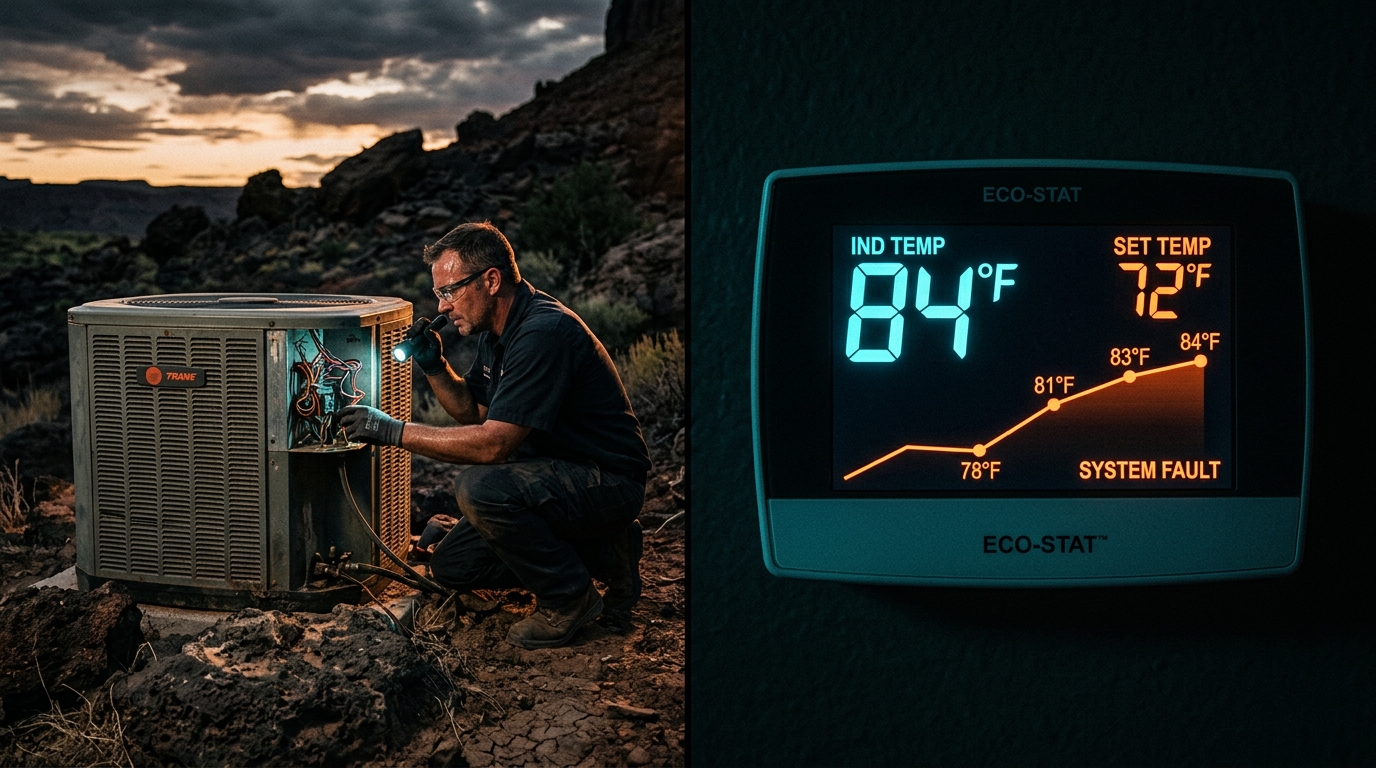
This is the question I get asked most by St. George homeowners when they find out I work in digital marketing: “so when should I actually replace my AC versus just fixing it?”
It’s not a marketing question. It’s a real one. And it’s particularly relevant here because Southern Utah has one of the most demanding HVAC climates in the country — 100+ degree summers that stretch from May into September, dry air that puts unique strain on equipment, and a geography that makes certain repairs more complicated than in other markets.
I’ve talked to several HVAC contractors in this area about this. Here’s what I’ve learned.
The simple math rule — and why it matters in St. George
The general rule among HVAC professionals: if the repair costs less than half the price of a new unit, and your system is less than 10 years old, repair it.
But that rule doesn’t account for the St. George factor. Systems here work harder. An AC unit in Phoenix or St. George runs significantly more hours per year than one in Phoenix or Denver. That extra wear and tear changes the math — a 7-year-old system that’s had a compressor failure in St. George might be a better candidate for replacement than the same situation in a milder climate.
The specific signs it’s time to replace
Your system is over 12 years old. Modern AC units last 15-20 years on average, but Southern Utah’s climate cuts that. A 12-year-old system in St. George is functionally older in terms of wear than the same system in Minnesota. When you’re looking at a major repair on a system in this age range, replacement is usually the better long-term call.
You’re repairing it more than once a year. If you’ve had three service calls in the last 12 months, you’re spending repair money that would be better applied to a new system. Each repair is also downtime — and in July in St. George, a weekend without AC is genuinely dangerous for children and elderly family members.
Your cooling bills are climbing. If your monthly electric bill jumps significantly in the summer without a corresponding increase in usage — meaning you’re running the same schedule but paying more — your system is losing efficiency. Newer units in St. George are significantly more efficient, and the energy savings alone can justify replacement over a 5-7 year window.
It’s running constantly and not keeping up. If you’re setting your thermostat to 76 and the house is sitting at 82, your system is undersized, failing, or both. That’s not a repair problem — that’s a capacity problem that only replacement solves.
The refrigerant is R-22. This is an older refrigerant that’s no longer manufactured. If your system uses R-22, it’s at least 15 years old. Repair costs for R-22 systems are skyrocketing because the refrigerant itself is increasingly expensive. Replacement is almost always the right answer here.
The specific signs you can repair
A single component failure on a relatively new system. A failed capacitor, a bad fan motor, a faulty thermostat — these are standalone component failures on a system that’s otherwise running well. If your system is under 8 years old and hasn’t had major issues before, repair makes sense.
The repair is under $500. Simple capacitor replacements, contactor repairs, thermostat replacements — these are sub-$500 fixes that are worth doing regardless of system age, assuming the system has been otherwise reliable.
You have a major project coming and want to defer. If you’re planning to sell your home in 2-3 years, or you’re mid-renovation, sometimes deferring a replacement decision makes financial sense even if it’s not the optimal long-term call.
What about heat pumps?
Heat pumps are worth a serious look for St. George homeowners, and they’re becoming more common in the market. They work efficiently in Southern Utah’s climate — even though it gets cold here in winter, it rarely stays below 20°F for long, which is within the effective range of modern heat pumps.
The economics are shifting in favor of heat pumps as utility costs change and the technology improves. If you’re replacing your AC anyway, the conversation about a heat pump swap is worth having. Most HVAC companies in the St. George area now install them.
The St. George-specific timing consideration
One thing contractors in this area mention frequently: the best time to replace an AC system in St. George is in the spring — April or May — before the peak cooling season hits. Contractors are less busy, you can often get faster service, and you go into the summer with a new system rather than gambling that your aging unit makes it through another July.
If you’re reading this in March or April and your system is showing signs of wear, now is the right time to get a quote, not July when every HVAC company in Washington County is swamped with emergency calls.
This is informational content for homeowners. If you’re an HVAC company in St. George or Washington County and you’d like to reach homeowners researching these questions, the free AI visibility scorecard will show you whether you’re showing up for the searches your potential customers are making.
Related reading:
- HVAC in Southern Utah: What Homeowners Actually Search For — the search data behind these questions
- Why Southern Utah Contractors Are Invisible to AI Search — the contractor side of this market
- Request a Free Audit →