How Tour Companies Get Found in AI Trip Planning Tools
How tour operators and adventure companies near Zion can get found in AI trip planning tools like ChatGPT and Perplexity.
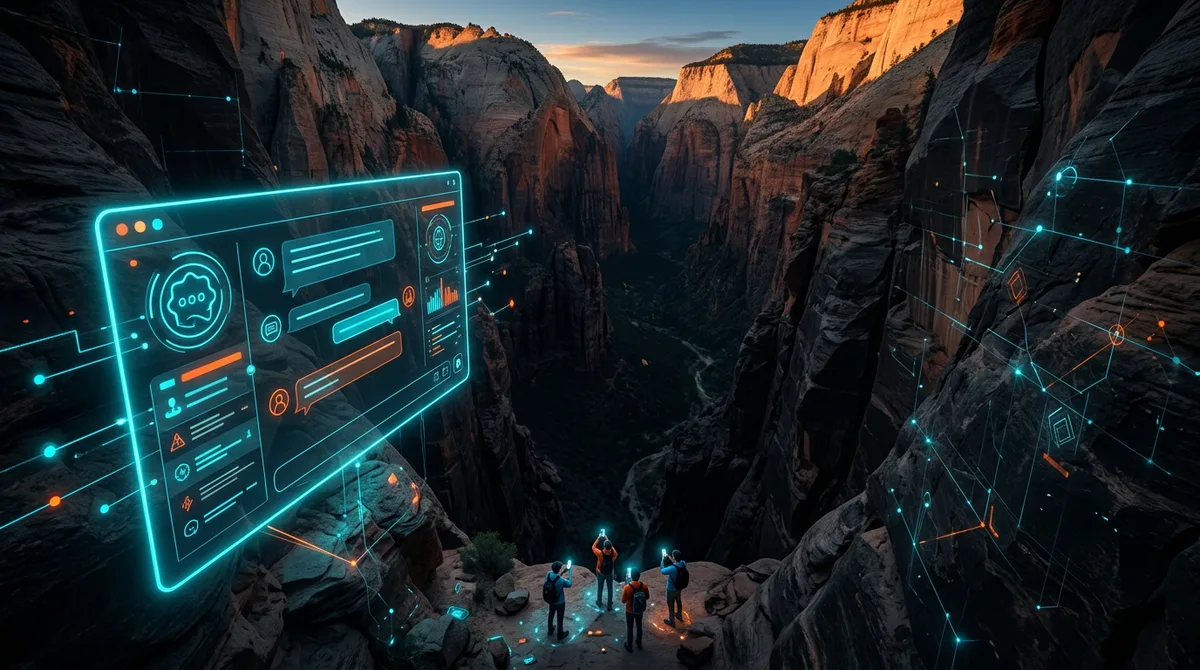
You’ve built a legitimate tour operation. You have the gear, the guides, the safety record, the repeat customers. But when a family in Ohio sits down to plan their Zion trip and asks ChatGPT “what’s the best guided canyoneering tour near Springdale,” your company might not come up at all.
That’s not a reflection of your quality. It’s a reflection of your digital footprint — and it’s fixable.
How Tourists Actually Find Tour Operators Now
Five years ago, a tourist would Google “Zion tour companies,” scan the first page, and pick based on reviews and website quality. That still happens — but it’s no longer the whole picture.
Today, a meaningful chunk of trip planning happens through AI assistants. Someone asks ChatGPT for recommendations. They ask Perplexity to compare options. They ask their phone’s voice assistant while driving. Each of these tools pulls from a different set of signals than Google does.
A Springdale ATV rental company that’s been operating for 12 years might not show up in ChatGPT recommendations — not because they’re bad at their job, but because their online presence was built for a Google-first world.
The question isn’t whether this shift is happening. It is. The question is whether your business shows up when it does.
The Three Signals AI Uses to Recommend Local Businesses
When an AI model recommends a tour operator, it’s drawing on three main signals:
1. Structured, consistent business information
This means your business name, address, phone number, hours, and service descriptions are the same across your website, Google Business Profile, Yelp, TripAdvisor, and anywhere else you’re listed. AI models cross-reference these sources. Inconsistencies create uncertainty — and uncertain businesses don’t get recommended.
2. Review volume and recency
Not just star ratings. AI models look at whether you have recent reviews, whether those reviews describe specific experiences, and whether the business owner responds. A tour company with 14 reviews from 2022 and nothing since looks dormant. A company with 8 reviews from the last 6 months — including owner responses — looks active.
3. Content that answers questions tourists actually ask
“Is canyoneering safe for beginners?” “What should I wear on a slot canyon tour?” “Do I need my own gear?” If your website answers these questions clearly, AI models can pull those answers and attribute them to you. If your website is a photo gallery and a booking form, there’s nothing to cite.
What Tour Operators in the Zion Corridor Are Missing
Here’s an honest look at what most small tour companies in the Springdale–Hurricane–Kanab corridor are missing:
No FAQ content on their website. The booking form loads fine but there’s no text explaining what the experience is actually like. AI can’t recommend what it can’t read.
TripAdvisor presence but no Google Business Profile. TripAdvisor matters, but Google Business Profile is what feeds AI recommendations for local searches. If you’re only on TripAdvisor, you’re invisible to a growing slice of the market.
Inconsistent business name across platforms. “Zion Adventure Tours” on one platform, “Zion Adventure Tours LLC” on another, “ZAT” on a third. These look like three different entities. Consolidate them.
No recent blog or content. Even a 500-word “what to expect on your first canyoneering trip” post, updated once a year, signals to AI that your business is active and informative.
The Fix: Not a Full Rebrand, Just Specific Work
You don’t need to hire a marketing agency. You need to spend about 4-6 hours on specific, targeted work:
Step 1: Claim and complete your Google Business Profile
If you haven’t already, claim your GBP at business.google.com. Fill in every field — not just the basics. Add your service areas (Springdale, Hurricane, Kanab, St. George). Add your specific tour types as services. Upload 10+ photos of actual tours. Set your hours accurately.
This alone is the highest- use move. Google Business Profile feeds both Google Maps AND many AI recommendations.
Step 2: Add a FAQ page to your website
Write out the 10 questions you get asked most often before someone books. Answer them directly and in plain language. These become the content AI pulls when someone asks “what’s the best guided tour near Zion?”
Example questions:
- What’s included in the tour?
- What fitness level do I need?
- Is it safe for kids/beginners/seniors?
- What happens if weather is bad?
- Do you provide all gear?
Step 3: Ask for reviews — and respond to them
After every tour, send a quick follow-up text or email asking for a Google review. Give them a direct link (not just “go leave us a review”). When reviews come in — good or bad — respond. This signals an active business.
Step 4: Make sure your business info is consistent everywhere
Check TripAdvisor, Yelp, Google, Facebook, your own website, and any local directories. Your business name, address, and phone number should be identical everywhere. Spend 30 minutes on this — it matters more than most people realize.
Step 5: Write one short blog post about your most popular tour
Not a sales pitch. A genuine “here’s what it’s like” post. 500-800 words. What people experience, what to expect, what makes it worth doing. This gives AI something to pull and cite.
The Compounding Effect
Here’s the thing about this work: you do it once and it keeps paying off.
A tour company in La Verkin that spent a Saturday getting their Google Business Profile right, adding a FAQ page, and asking their last 20 customers for reviews — they’re not doing ongoing marketing work. They did it once. But now they’re showing up in AI recommendations for “ATV tours near Zion” and “family-friendly outdoor tours Hurricane Utah.”
The companies that don’t do this work are getting passed over not because they’re worse — but because the AI doesn’t know enough about them to recommend them.
Your Next Move
If you run a tour company, guide service, gear rental, or any outdoor experience near Zion, Bryce Canyon, or the surrounding corridor, this is a good week to spend a few hours getting your digital house in order.
Not because there’s some emergency. But because tourist season is coming, AI search is growing, and the businesses that show up in those recommendations are going to have a competitive advantage that compounds over time.
Not sure where your business currently stands? Take the free AI Visibility Scorecard at /scorecard — it’ll show you exactly where you’re visible and where you’re not, in about 3 minutes.
Frequently Asked Questions
Does my tour company need a website to show up in AI search? A proper Google Business Profile can get you into AI recommendations even without a full website. That said, a simple website with a FAQ page dramatically improves your chances — because AI models prefer to cite sources that answer questions in detail.
How long does it take to see results after improving ? Google Business Profile changes can surface in search within a few weeks. Getting cited by AI models like ChatGPT takes longer — typically 2-4 months — because these models update on their own crawl schedules. The work you do now pays off going into peak summer season.
Do I need to be on every platform? No. Focus on Google Business Profile first, then TripAdvisor and Yelp. Those three cover the majority of AI recommendation sources for tourism businesses. Don’t spread yourself thin trying to be everywhere.
What if I don’t have time to write content? Start with just the FAQ page — it’s the highest- use content move and doesn’t require you to be a writer. Answer the questions you already answer by phone, every day. That’s your content.
Related: How Tourists Plan a Zion Trip in 2026 (And What That Means for Your Business) — understanding the planning behavior helps you see where the opportunities are.
Also worth reading: The Small Business Owner’s Guide to AI and Modern Search in Southern Utah — the full picture on what’s changing and what to do about it.