
Why Southern Utah Dentists Need to Think About AI Search (Yes, Really)
Most dental practices in St. George and Washington County are competing for the same Google Ads keywords. There's a quieter, cheaper, more durable path to filling your chair — and it starts with understanding how patients actually find dentists in 2026.
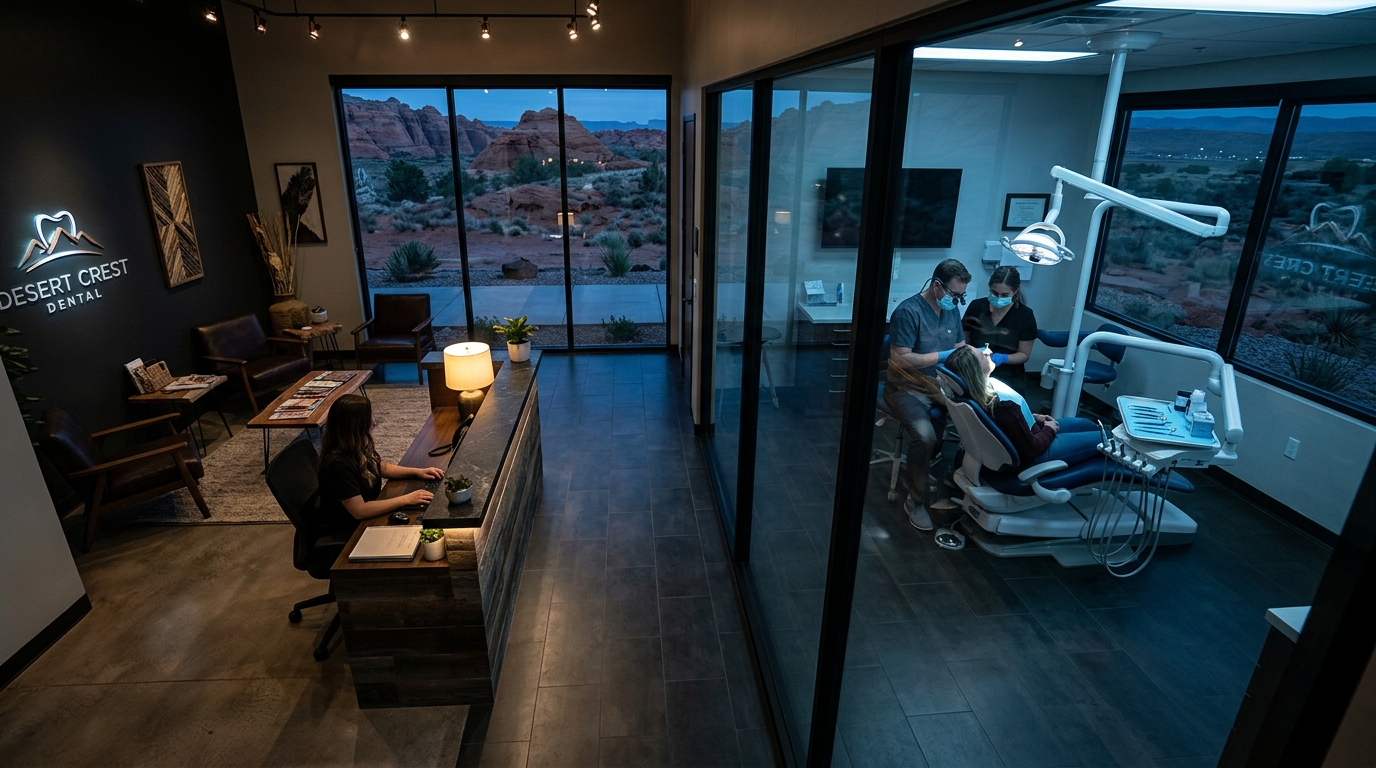
I’ve talked to a lot of dentists in St. George and Washington County over the past year. The conversation almost always starts the same way: “Our Google Ads are getting expensive and the leads aren’t what they used to be.”
Then they tell me they have a website, they’ve been doing SEO for a while, and they’re not sure what else to do.
Here’s what I’ve noticed: almost none of them are doing anything specific for AI search. And almost all of them have the same assumption — that their current patients are their referral base, and new patients come from insurance directories or Google Ads.
Both of those assumptions are becoming less true every month.
How patients are finding dentists in 2026
The dental patient journey has changed more in the last two years than in the previous ten.
A few years ago, finding a new dentist meant asking friends, checking your insurance directory, or searching “dentist St. George” on Google and picking from the results.
Now, it’s more complicated and more fragmented:
Insurance directories are still important, but they’re not the whole picture. Patients with insurance still start with the insurer’s provider finder. But patients without insurance — a growing segment in Washington County — are searching differently. They’re asking AI engines for recommendations. They’re looking for dentists on TikTok and Instagram. They’re reading reviews on multiple platforms before they make a choice.
AI engines are becoming a referral source. When I ask ChatGPT “who is a good dentist in St. George for families,” it gives me names. When I ask “what’s a good dentist near me in St. George that takes new patients,” it gives me names. Those names come from somewhere — training data, web citations, directory listings, reviews. The dentists who show up in those answers are getting patients who never clicked on a Google Ad.
Reviews drive the decision. More than almost any other factor, review count and recency drive which dental practice a new patient calls. A practice with 50 reviews from the last six months looks different from one with 150 reviews from 2022. The recency signal matters more than the total count.
The dental AI search opportunity
Dentists have a significant advantage in local AI search that most of them aren’t using: they’re already doing most of the foundational work.
Most dental practices have a website. Most have a Google Business Profile. Most have at least some reviews. The problem isn’t that dentists are starting from zero — it’s that they’re not going far enough.
Specifically, three things would move the needle significantly:
FAQ content on their website. AI engines extract direct answers from websites. A dental practice that has a page answering “how often should I get a teeth cleaning in St. George,” “what should I do if I have a dental emergency on the weekend,” “do you take Delta Dental,” “what’s included in a new patient exam” — these pages are source material for AI citations. Most dental websites don’t have them.
Cross-platform reviews. AI engines verify dental practices by looking at reviews on Google, Yelp, Healthgrades, and dental-specific platforms. A practice with reviews on all of these looks more established than one with reviews on Google alone.
Being mentioned in content. This is the hardest and slowest part, but also the most durable. Practices that are mentioned in local news articles, community websites, or patient education content get cited by AI systems because those citations signal authority. The local dentist who writes a blog post answering common patient questions — and gets picked up by the St. George News — is building something that compounds over time.
The insurance question
Washington County has a high percentage of patients on Medicare Advantage and traditional Medicare dental benefits, plus a growing uninsured population. These are two very different patient groups with very different search behaviors.
Medicare dental patients tend to be older, more likely to search by asking a friend or calling the number on their insurance card, and less likely to be active on social media or AI search.
Uninsured patients — particularly younger uninsured adults and immigrants — are more likely to search for affordable dental care options online, including AI search. They may ask “who takes new patients in St. George with no insurance” or “where can I get a teeth cleaning for under $100 in Washington County.”
These searches are happening. The practices that appear for them are the ones that have addressed the specific questions in their content and their directory listings.
What this means practically
The practices that are going to grow in Washington County over the next three years aren’t necessarily the ones with the biggest marketing budget. They’re the ones that are findable in the places patients are searching — including places that didn’t exist as referral sources five years ago.
That means building the signals that make AI citation possible: complete directory listings, structured data on the website, FAQ content that answers real patient questions, and reviews that demonstrate active, current practice.
None of this requires a massive budget. It requires understanding what patients are actually searching and building the content to answer those questions.
Dental practices in St. George and Washington County: the free AI visibility scorecard will show you exactly where you stand in both traditional and AI search — in 5 minutes, with a written report you can act on.
Related reading:
- What St. George Businesses Get Wrong About AI Search in 2026 — the common misconceptions
- Why Big Chains Show Up in AI Search and Your Local Business Doesn’t — the structural pattern
- Take the Free AI Visibility Scorecard →