
Answer Engine Optimization: How St. George Businesses Get Named in AI Answers
AEO — Answer Engine Optimization — is the practice of structuring your online presence so AI systems extract and use your business as the answer to customer questions. Here's how it works for St. George businesses.
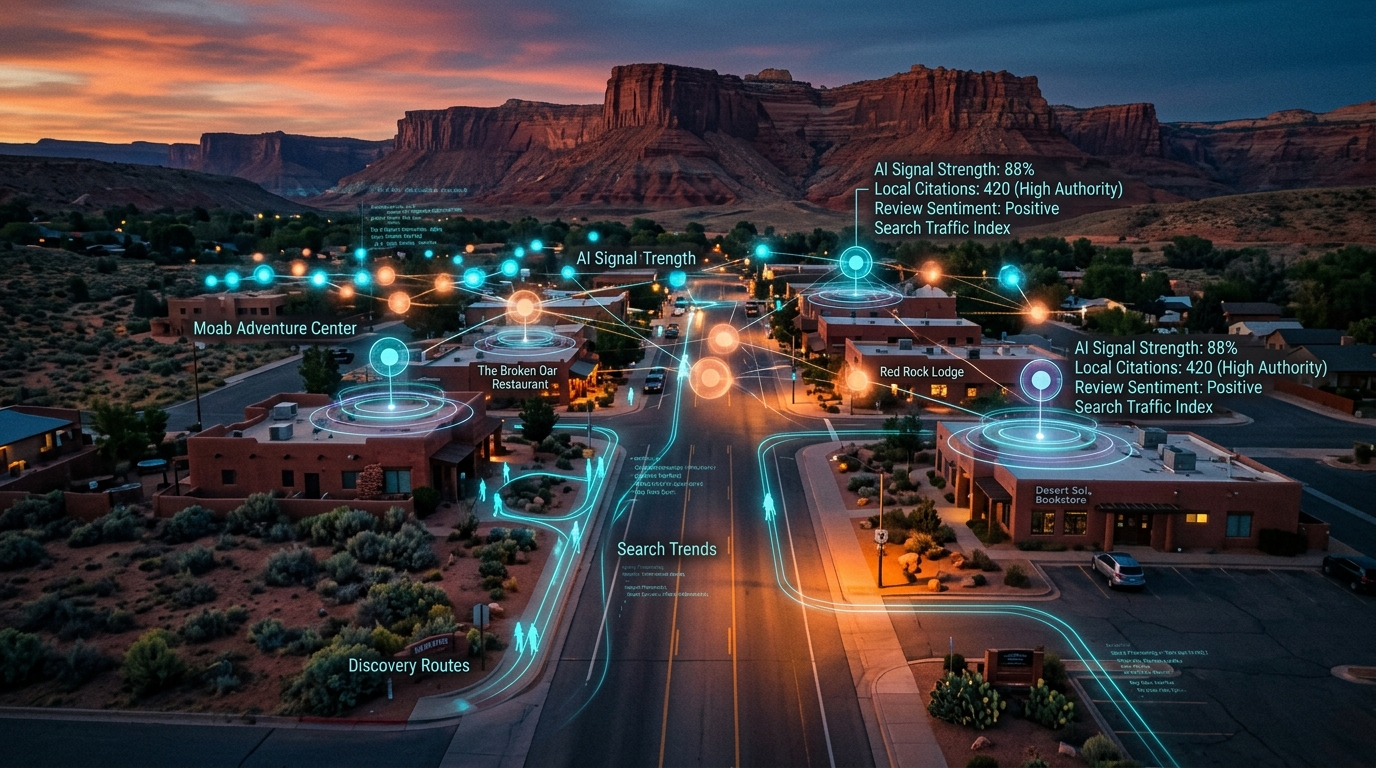
Search three years ago and you got a list of websites. Search today and you get an answer. That’s the fundamental shift that Answer Engine Optimization — AEO — is built around.
The difference between search and answer engines
Google is a search engine. You type what you’re looking for, you get a list of pages, and you click through to find the answer yourself.
ChatGPT, Perplexity, and Google’s AI Overviews are answer engines. You ask a question, you get a direct answer — often with no click required.
For St. George businesses, this changes everything about how customers find you. When someone asks “what’s a good dentist in St. George?” an AI answer engine gives them two or three names. Everyone else doesn’t exist in that conversation.
That’s not a ranking problem. That’s a visibility problem. And it’s one that most St. George businesses haven’t started solving yet.
How answer engines decide what to recommend
AI answer engines don’t crawl the web in real time. They build knowledge from data that’s been collected, structured, and verified over time. When they make a local recommendation, they’re drawing from a set of signals:
Proximity and location data. The AI needs to know you serve St. George and the surrounding area. This comes from your website’s structured data, your Google Business Profile, and citations across local directories.
Business category and services. What do you actually do? This comes from your GBP categories, your website’s service pages, and how consistently that information appears across the web.
Trust and authority. Does this business look real and established? Reviews, directory listings, press mentions, and how long the business has been operating all feed into this.
Direct answer content. Can the AI extract a clear, factual answer from your website? This is where your content strategy matters — if your site has FAQ pages with direct, well-structured answers, you’re providing source material for AI recommendations.
Images and media. Businesses with photos on their GBP and website are perceived as more real and active. The Zion tourism corridor businesses that post regular photos of their operation look different to AI systems than ones with no images.
Why most St. George businesses are invisible to answer engines
I test this constantly. I ask ChatGPT, Perplexity, and Gemini the same questions about St. George businesses — dentists, HVAC companies, plumbers, restaurants. The results are always the same: the big national brands show up, national directories show up, and one or two well-established local businesses show up.
Everyone else is missing.
The reason is almost always one of these:
No structured data. The business website has no JSON-LD schema markup. AI systems can read the content but can’t confidently extract verified facts about the business.
Inconsistent NAP. The business name or phone number varies slightly between its website, its Google listing, and its Yelp listing. To an AI, that looks like potential misinformation.
No direct answer content. The website is all marketing language — “we provide top-quality services for our valued customers” — with no specific facts, hours, prices, or FAQ-style answers that AI systems can extract and cite.
No images or very few. A bare Google Business Profile with no photos tells AI systems the business isn’t actively operating.
Zero directory presence beyond Google. Businesses that only exist on Google — nothing on Yelp, BBB, Expertise.com, or industry directories — look thin to AI systems that are used to cross-referencing multiple sources.
The three things that move the needle fastest
If you’re a St. George business owner and you want to start showing up in answer engine results, here’s where to focus:
1. Fix your Google Business Profile completely. Every field. Categories, attributes, service list, photos, posts, hours. This is the single highest-signal action you can take.
2. Add FAQ content to your website. Not marketing copy — actual questions your customers ask, with direct answers. “How much does a typical HVAC installation cost in St. George?” “What brands do you service?” “Do you offer emergency calls?” Put those on your site with clear H2 headings and paragraph answers.
3. Get your NAP consistent everywhere. Run a citation audit. Your business name, address, and phone number should be identical on every platform. Pick one format and stick to it.
What this looks like when it works
I’ve been testing this approach on my own business. I asked ChatGPT “who does SEO in St. George?” four months ago and wasn’t mentioned. After completing the GEO foundation — structured data, GBP optimization, citation building, FAQ content — I asked again.
I’m not at the top of that list yet. But I’m in the conversation now. And for a 5-month-old domain with no reviews and no local network, that’s real progress.
The same approach works for any St. George business. The businesses that start building these signals today will be the ones that show up in AI recommendations six months from now.
Related reading:
- What Is GEO? The Complete Guide to Generative Engine Optimization — GEO and AEO are closely related; this is the full picture
- Why Your St. George Business Won’t Appear in ChatGPT Search — a St. George-specific look at the problem
- The 15-Minute Check: Is Your Business Visible Online? — a free self-audit you can do today